
WHEN THE DEAD COULD STILL SAVE THE LIVING
WHEN THE DEAD COULD STILL SAVE THE LIVING:
A QUESTION FOR US IN IGBO LAND
Lately, a thought has refused to leave my mind.
It’s not loud, but it’s persistent.
And it sits right at the intersection of culture, fear, belief, and compassion.
I am Igbo.
And in Igbo land, we are deeply attached to our dead. We honor them.
We protect them.
Sometimes, we even guard them jealously.
But here’s the uncomfortable question, are we protecting tradition, or are we denying life?
Imagine this scenario.
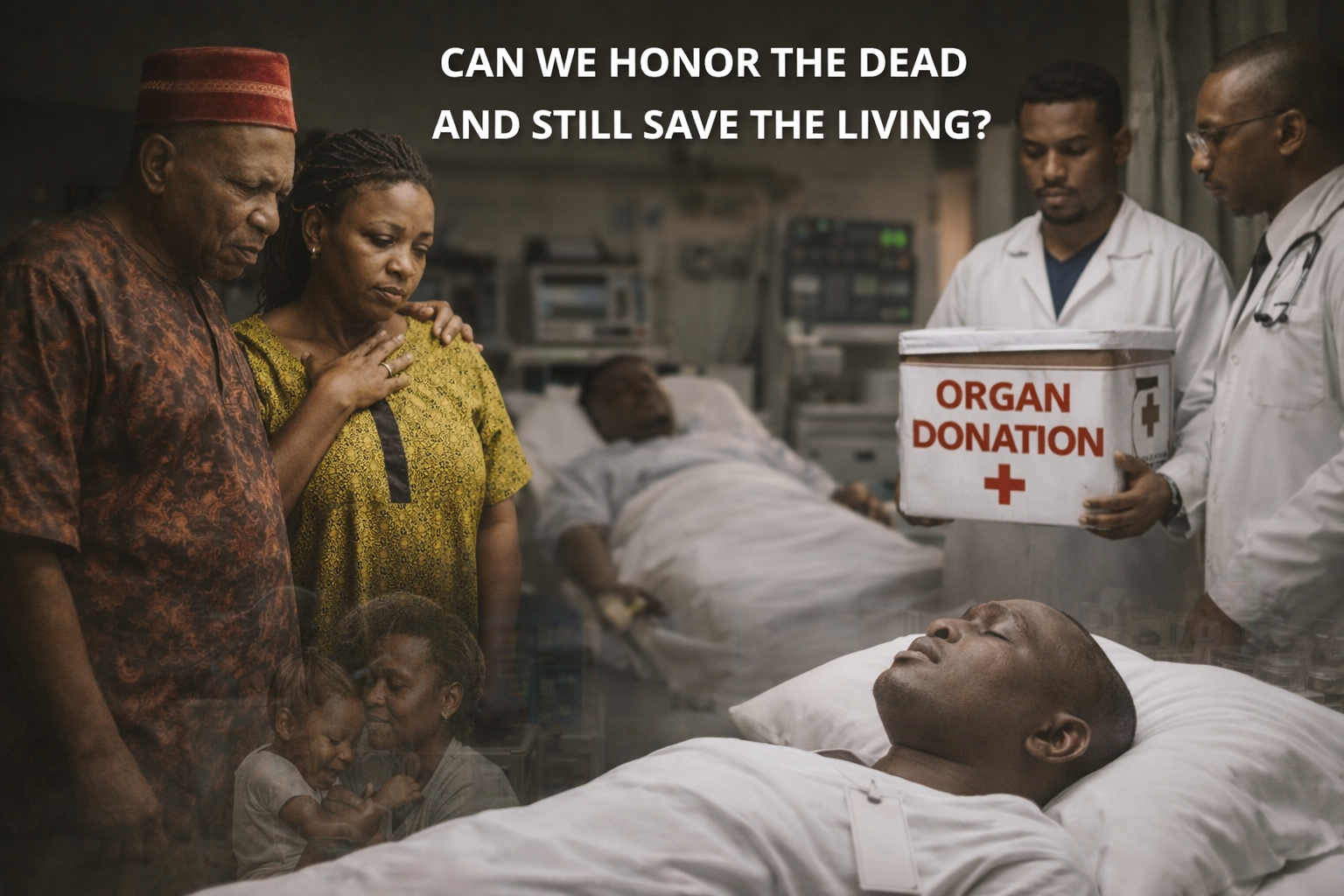
Someone from a family is involved in an accident. They are rushed to the hospital, but they don’t make it.
The doctors confirm death.
Yet, their heart was strong.
Their kidneys were working.
Their liver was healthy.
In another room in that same hospital, someone is dying.
Kidney failure.
Liver failure.
Waiting.
Hoping.
Praying.
And still, we say no.
Not because the organs are bad.
Not because donation is impossible.
But because “we don’t do that.”
Because cutting out a part of the body feels like dishonor.
Because the body must be buried complete.
Because of fear of the unknown.
Because of stories we heard growing up.
So we choose wholeness in death over wholeness in life.
And that’s where the question hurts.
What exactly are we afraid of?
That the dead will not rest?
That they will be incomplete in the afterlife?
That something spiritual will be lost?
Yet, every day, people are dying not because medicine failed, but because organs were unavailable.
There are mothers who could live if a kidney was available.
Children who could grow if a liver was donated.
Fathers who could return home if a heart came on time.
And sometimes, those organs are right there.
Already lost to death.
Still useful.
Still strong.
I understand culture.
I respect it.
Culture gives us identity.
But culture is also meant to protect life, not prevent it.
Even in life, we give.
We donate blood.
We donate money.
We donate land.
We donate time.
Why does giving suddenly stop at death?
Normalize saying this, while alive, “If I die suddenly, let my organs save others,”
Its not wishing yourselves death or bad, its called intentionality
It is a final act of love
In many parts of the world, organ donation is seen as legacy.
You die, but a part of you continues to live.
You are buried, but your kindness is breathing in another body.
Here, we call that disturbing the dead.
Maybe it’s time to ask: who benefits from our refusal?
Certainly not the dead.
Certainly not the living who are waiting.
This is not a call to abandon culture.
It is a call to examine it.
To ask whether some beliefs came from fear rather than wisdom.
We already accept surgeries.
We accept transfusions.
We accept medical intervention.
Yet, when death comes, we suddenly draw a line.
Why?
Even people on their deathbed, conscious and willing, should have the right to say, “Let something good come out of this.”
Because death is painful.
But death that saves others carries meaning.
I don’t have all the answers.
I’m asking the questions.
Should we, as a people, begin to rethink organ donation?
Can we honor the dead and still save the living?
Is refusing to donate truly respect, or just tradition we’ve never challenged?
I’d like to hear your thoughts.
Not arguments.
Not insults.
Just honest opinions.
Because sometimes, the dead still have something powerful to give, if only we let them.
Maybe with this we can minimize the unnecessary k!lling of living healthy people for parts.
That’s a topic for another day
©️Duru Eunice Adaku
24/1/2026


