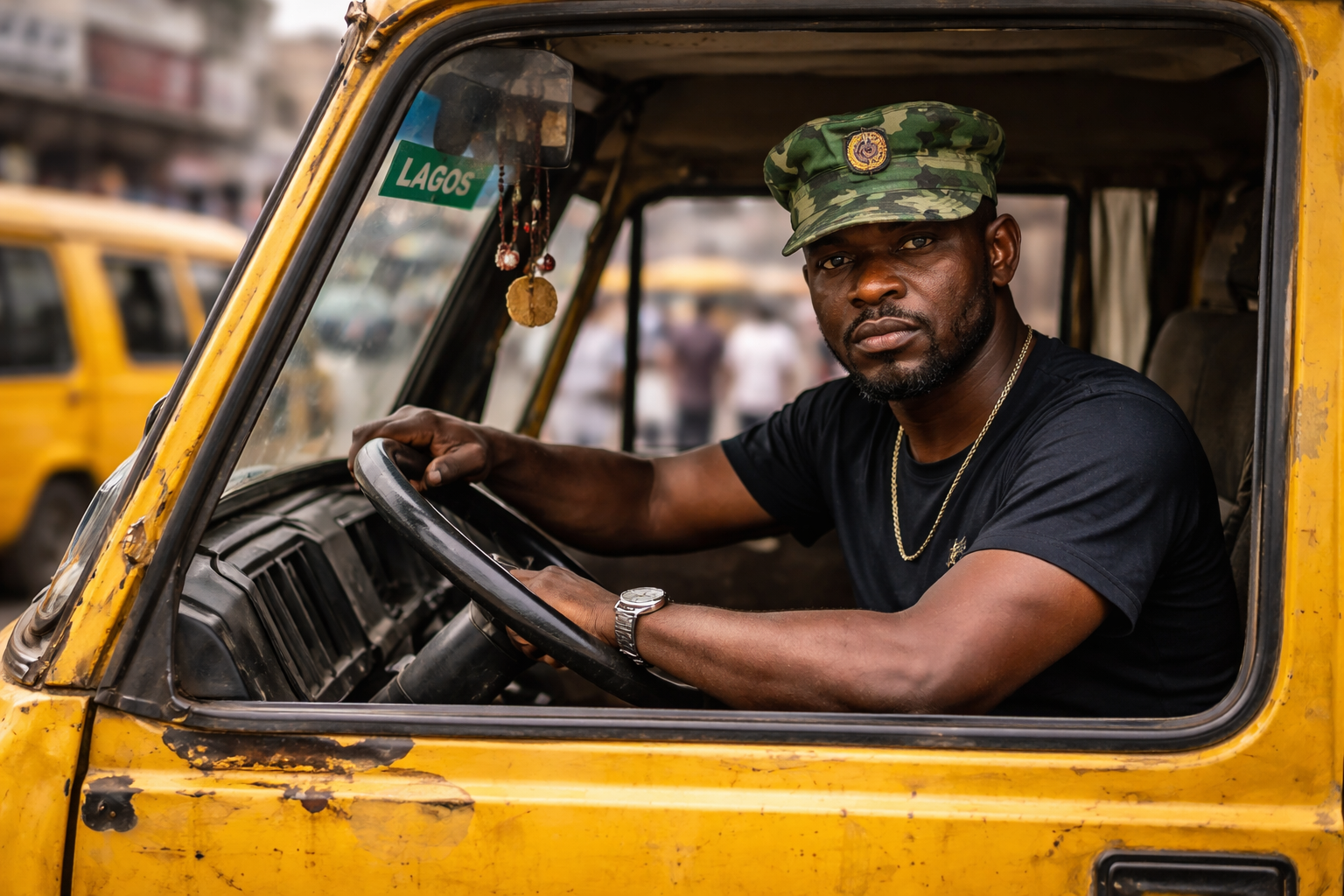
Welcome to Lagos, Nigeria, where every bus driver is either a soldier or a police officer
Welcome to Lagos, Nigeria, where every bus driver is either a soldier or a police officer
If you’ve lived in Lagos long enough, you’ve heard it.
If you’ve entered a danfo, korope, shuttle bus, or even a bike, you’ve been told it.
“I be soldier.”
“I be police.”
“Madam, no talk too much, I be officer.”
It’s almost a rite of passage. The moment a disagreement starts, a badge appears verbally. Not an ID. Not a uniform. Just words. And somehow, those words are expected to end the conversation, silence complaints, and excuse behavior that would never be acceptable anywhere else.
Here’s the thing. This isn’t even about whether they are truly soldiers or police officers. That debate alone could fill a book. The bigger question is this:
If they really are military or police officers, how do they have this much time to run a full-blown transport business?
Because driving in Lagos is not a side hustle. It’s a full-time war.
Lagos driving is not part-time work
Let’s be honest with ourselves.
Driving a bus in Lagos means waking up before dawn, fighting traffic, dodging LASTMA, bribing your way through checkpoints, arguing with passengers, managing conductors, fixing breakdowns, and still having the energy to repeat the cycle the next day.
This is not “I close by 2pm” work.
This is not “I do it on weekends” work.
It is physically exhausting. Mentally draining. Emotionally chaotic.
So when someone claims they are an active soldier or police officer and still drives a commercial bus daily, a logical question follows:
Is their official job not demanding enough?
Because if it is, something is not adding up.
The possible explanations no one wants to say out loud
Let’s break it down honestly, without insults and without pretending.
1. Economic pressure
Nigeria is expensive. Lagos is brutal.
Salaries for many uniformed officers are painfully low compared to the cost of living. Some people genuinely take extra jobs to survive. Feed families. Pay rent. Send children to school.
This part deserves empathy. No argument there.
But survival does not excuse intimidation, recklessness, or misuse of authority, real or imagined.
2. Identity inflation
In Lagos, authority carries weight. Saying “I’m a soldier” instantly changes how people react. Passengers calm down. Traffic wardens step back. Arguments die down.
So some drivers borrow authority they don’t have, because it works.
It’s social armor. Not truth.
3. Poor regulation
If active officers truly have enough free time to run transport businesses openly, then the system itself is broken. Security agencies are meant to be understaffed, overstretched, and constantly on duty.
If that’s not the reality, then either manpower is being mismanaged or standards have slipped quietly.
4. The culture of fear
Many Nigerians have learned not to challenge anyone who claims uniform power. We’ve seen what can happen. So we stay quiet, even when we’re being cheated, endangered, or disrespected.
Drivers know this. And some exploit it.
Are there any pros at all?
Let’s be fair.
Some drivers who claim military or police background actually drive better. They respect road signs. They avoid unnecessary fights. They keep some discipline.
Some passengers feel safer, believing an “officer” is less likely to be reckless or criminal.
And yes, extra income can reduce desperation, which in theory could reduce corruption elsewhere.
These are valid points.
But they don’t outweigh the damage.
The cons are louder than the horns on Third Mainland Bridge
Here’s where the real problem lies.
False authority breeds lawlessness.
When everyone is a “soldier,” no one is accountable.
Reckless driving becomes justified.
Speeding, wrong-way driving, verbal abuse, and threats suddenly get wrapped in uniform language.
Public trust erodes.
When people constantly meet “soldiers” behaving badly, real officers lose respect by association.
Safety takes the back seat.
Passengers are less likely to speak up about dangerous driving when intimidation is in the air.
And perhaps the biggest issue of all:
It normalizes chaos.
What this really means
This is not just about bus drivers.
It’s about a society where authority is loosely worn, easily claimed, and rarely verified.
It’s about a system where people feel the need to borrow power to be treated fairly.
It’s about institutions that don’t pay enough, don’t monitor enough, and don’t enforce enough.
And it’s about everyday Nigerians navigating all of this just to get from point A to point B alive.
The uncomfortable final question
If our soldiers and police officers truly have the time and energy to run transport businesses daily, then maybe their official duties are not structured properly.
If they don’t actually have those jobs and are only using the titles to intimidate civilians, then we have a deeper cultural problem.
Either way, something is wrong.
Because authority should protect people, not silence them in a moving vehicle with faulty brakes and a driver who thinks shouting “I be officer” is a driving license.
Welcome to Lagos.
Where traffic is normal, chaos is expected, and apparently, everyone is in uniform.